Sometimes, to discover a place that will impress us, we think we have to go far away. That true beauty lies in exotic gardens, in foreign cities, in places we see in photos on Social Media and that we promise ourselves we will visit one day. And yet, there are places in Romania where you can cross continents, eras and plant worlds in just a few hours. One of them is right in the heart of Cluj.
The "Alexandru Borza" Botanical Garden is not a place where plants tell stories.
Stories about time, about patience, about science, about beauty and, perhaps most importantly, about how man has tried to understand and preserve the plant world.
A garden with more than a century of history
The history of botany in Cluj begins long before the garden we know today took shape. The city's first botanical garden operated since the early 19th century, near the Reformed College. It had outdoor and greenhouse plant collections and was supported by the amateur botanist Wolfgang Cserey, who already dreamed of establishing a national botanical garden in Cluj.
Later, the development of university education laid the foundations for a true academic institution. The establishment of the Transylvanian Museum Society in 1859 and the Franz Joseph University of Cluj in 1872 led to the emergence of an academic botanical garden, organized by Professor August Kanitz on land donated by Count Mikó.
At the beginning of the 20th century, the idea of a larger garden began to take shape. Professor Aladár Richter purchased a plot of land of approximately 9 hectares in the southern part of the city, in the area where the garden is located today. However, World War I would slow down the development of the project.
The decisive moment would come after 1919, when Professor Alexandru Borza was given the mission of finalizing the organization of the new Botanical Garden of the University of Cluj. Borza expanded the area to 14 hectares and conceived the garden according to modern principles for that period, combining science with ecology, education and landscape refinement. It was not intended only as a place where plants could be collected and studied, but as a space where people could learn to look at them and understand them.
On June 25, 1925, the garden is officially opened to the public.
Today, more than a century after its beginnings, it continues to fulfill the same three major roles: research, education and plant world conservation, while remaining one of the most beloved places in Cluj.
A little "around the world" in Cluj
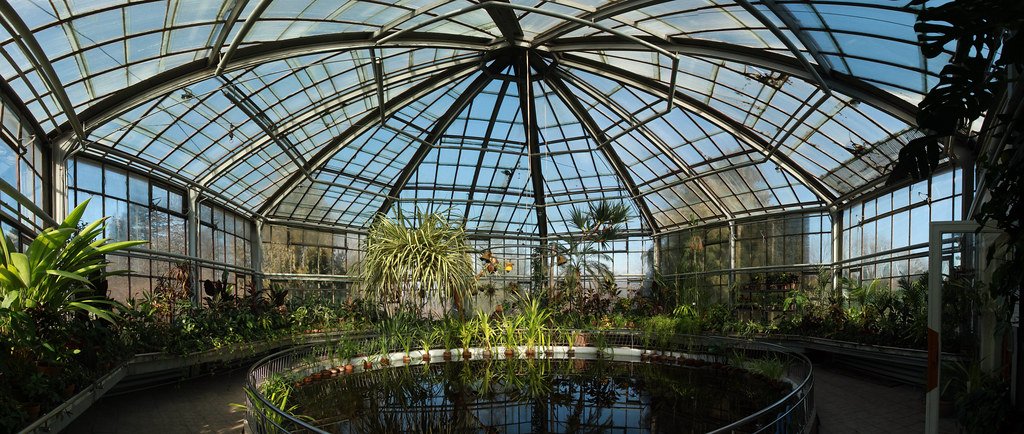
Perhaps one of the most beautiful things about the Botanical Garden is the feeling that, once you step through its gates, the city is left behind. Along the alleys, the world seems to expand. One sector takes you to the flora of a specific geographical region, another takes you closer to botanical families and plant relationships, and the greenhouses open a window to the warm regions of the world. The garden is organized into several sectors – ornamental, phytogeographic, systematic, economic and the greenhouse complex – which together house approximately 10,000 plant categories.
And for lovers of ornamental plants, the ornamental sector is perhaps one of the most spectacular places. The collections change with the seasons, and the colors of the garden are never exactly the same.
Roses, tulips, daffodils, hyacinths, dahlias, cannas, gladioli, lilies – each season has its own show. The rose collection includes approximately 250 species, and the succession of flowers transforms the garden from one month to the next.
And then there is the Japanese Garden.
A space where the pace slows down almost instinctively. With its pond, teahouse and composition inspired by traditional Japanese style, it is one of those places where you don't feel the need to do anything but look. Perhaps this is one of the great qualities of a well-thought-out garden: it doesn't ask you to rush.
The place where plants are not just decoration
For a plant lover, a botanical garden can be overwhelming in the most beautiful sense. You no longer just look at a plant because it's beautiful. You begin to notice the shape of a leaf, its texture, the way a particular species has adapted to its environment, the differences between two plants that, at first glance, seem similar. You begin to understand that each plant has its own rhythm and its own needs.
A botanical garden is, in a way, a living library. Only instead of shelves you have aisles, instead of pages you have leaves, and instead of stories you have species gathered from different worlds.
In Cluj, this living library also has an important scientific dimension. The garden was and continues to be a center for botanical research and education, and the Botanical Museum and herbarium preserve an essential part of the memory and knowledge of the plant world.
A place where you come back different
Maybe this is the true magic of a botanical garden. You don't just leave with photos. You leave with a different perspective. Maybe you take a closer look at your houseplant. Maybe you wonder what species that shrub you pass by every day is. Maybe you start to see a flower not just as a splash of color, but as the result of an incredibly long history of nature.
And maybe you remember something simple:
Plants are not just what we have in pots, in gardens or in parks. They are part of the world we live in.
And the better we get to know them, the more we begin to see.
That's why a visit to the "Alexandru Borza" Botanical Garden can be, for a plant enthusiast, more than just a walk.
It can be a little escape.
A botany lesson.
A source of inspiration.
A moment of silence.
Or simply an afternoon where you remember how beautiful the world can be when you choose to look at it carefully.
And if we love plants, perhaps this is one of the most beautiful places where we can start looking at them differently.
Without leaving Romania.